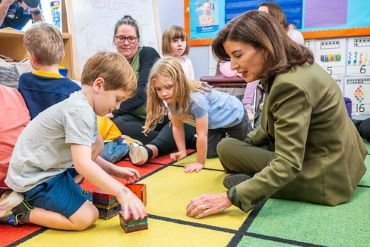
New York Governor Kathy Hochul officially announced on Friday, October 9, 2026, that New York State will participate in President Donald Trump’s federal Education Freedom Tax Credit program. The decision makes New York the 31st state overall—and only the second state led by a Democratic governor, following Colorado's Jared Polis—to opt into the nationwide school choice framework.
As of October 2026, 30 states have now officially opted into the federal Education Freedom Tax Credit (IRC §25F).
The program—which was established under the Trump administration and goes into effect on January 1, 2027—allows individuals to receive a federal tax credit of up to $1,700 annually for donating to approved scholarship-granting organizations (SGOs). However, because the program relies on voluntary state participation, families can only access these scholarships if their state's governor or legislature formally opts in.
The funds generated will provide scholarships for families. Private and parochial school families can use them to defray tuition costs, while public school students are eligible for scholarships covering tutoring, after-school programs, transportation, or school supplies.
The federal program, which passed last year under the One Big Beautiful Bill Act, is scheduled to take effect for New York families starting next school year (2027).
Participating students' household income cannot exceed 300% of their area's median gross income.
Governor Hochul had signaled intent to join the program earlier in the year but delayed her formal decision until the U.S. Treasury Department and the IRS released their regulatory guidelines on October 1. In an official statement from NY.gov, Hochul emphasized that she chose to opt in only after confirming that the finalized rules included explicit pathways for public school students to benefit alongside private ones.
The move has drawn praise from school-choice advocates, including the Catholic school system, which noted it makes values-based education more accessible. However, it faces intense backlash and opposition from traditional public school advocates and powerful teachers' unions, who contend that redirecting public funds toward private education models harms struggling public school systems.
The 30 states that have officially finalized their enrollment in the program include: Alabama, Alaska, Colorado, Florida, Georgia, Idaho, Indiana, Kansas, Kentucky, Louisiana, Mississippi, Missouri, Montana, Nebraska, Nevada, New Hampshire, North Dakota, North Carolina, Ohio, Oklahoma, South Dakota, Tennessee, Texas, Utah, Virginia, West Virginia, and Wyoming (along with three other finalized states to reach the 30-state IRS roster).
In states like Kansas, Kentucky, and North Carolina, Republican-controlled legislatures successfully overrode vetoes from their Democratic governors to force participation in the program.